
Press Enquiries
For interviews, images, press information or enquiries about public monuments and commissions, please contact: info@poppyfieldfineart.com
PRESS AND MEDIA
Poppy Field’s public monuments and figurative sculpture have been featured by national and international media including BBC News, Sky News, The Times, The Telegraph, Vanity Fair, The Evening Standard and Londonist, alongside institutional, lifestyle, and arts publications including The Courtauld, The Leverhulme Trust, Surrey Life, Hertfordshire Life, The Illustrated London News, and Unpolished Magazine.





Featured Coverage
The Leverhulme Trust, June 2026
A tradition carried forward: what a Leverhulme Studentship made possible
A decade after a Leverhulme Study Abroad Studentship, sculptor Poppy Field reflects on what that year made possible: public monuments and a book dedicated to preserving and passing on a sculptural tradition.
When I first wrote for the Leverhulme Trust in 2017, I was a student with an ambition: to complete my training in figurative sculpture and, one day, contribute to the UK’s tradition of public monuments and memorials. I could describe what I hoped to learn, from working from life under natural north light to understanding anatomy and casting in bronze, but I could only guess at what that knowledge would eventually make possible. The Study Abroad Studentship funded my third and final year at The Florence Academy of Art. The programme was built on cumulative looking. Each session in the studio trained us not simply to reproduce what we saw, but to understand form in space, to compare, to question and to translate rather than copy nature. What I did not fully anticipate was how completely that training would shape me as a sculptor. When I was later commissioned to create bronze monuments of Queen Elizabeth II and Prince Philip for the Royal Albert Hall, unveiled by King Charles III and Queen Camilla in 2023, the questions I asked about gesture, proportion, anatomy and character were the ones I had learned to ask in Florence.
Of course, public sculpture asks more than technical competence. It also requires judgement about likeness, memory, material, site, scale and public encounter. These are questions I first approached at The Courtauld Institute of Art, where a longstanding fascination with collective memory and monuments was shaped into something more rigorous and then tested in practice in clay. That combination of figurative sculpture training and a background in the history of art also shapes the book I have co-authored with Robert Bodem, Drawing in Space: Theory & Practice of Figurative Sculpture. Robert founded and led the Sculpture Program at The Florence Academy of Art, where he developed the method over more than two decades of teaching. Much sculptural knowledge is transmitted quietly, through demonstration, correction, repeated looking, and the exact question asked at the right moment. The book is an attempt to make more of that process visible and available. The Leverhulme Trust funding gave me not only a way of working, but also a responsibility: to contribute to the tradition that trained me, whether through public sculpture, collaboration or the written record. Drawing in Space is part of that effort.
The Society of Portrait Sculptors: FACE2025 Exhibition Catalogue
First Sight: Torso of a Crouching Woman, 1884-5. Camille Claudel.
Artists and art lovers know how viscerally life is punctuated by first sights. As a small child, the Seagram Murals in the Tate’s Rothko Room filled me with wonder and awe. At eight, my mother found me petrified and sobbing before the Gates of Hell during a trip to the Rodin Museum in Paris. As a teenager, I marvelled at Edgar Degas’s Little Dancer of Fourteen Years on show at the Royal Academy. Encased in a vitrine, she seemed both younger and older than me all at once. At the Courtauld, three-dimensional space was redefined in a heart-wrenching beat when my professor projected Rachel Whiteread’s Judenplatz Holocaust Memorial onto the wall. In Florence, I spent years detouring through the Piazza della Signoria to gaze up at Benvenuto Cellini’s Perseus with the Head of Medusa. It changed with the light and, like my own face, became familiar yet never truly known to me. I never seemed to mind that, but from the moment I saw Camille Claudel’s Torso of a Crouching Woman burning through the small screen of my phone, I yearned to lay my hands on its violent surface and make sense of how that tumultuous form, headless and armless, stripped of all but its essence, seems so tenderly alive.
Claudel was born in 1864 and as a child demonstrated a remarkable gift for sculpture. Although her mother disapproved, her father encouraged her and arranged for her to receive rudimentary tuition from Alfred Boucher. Claudel then moved to Paris and took sculpting lessons at the Académie Colarossi, which, remarkably for the time, allowed female students to draw from life. Boucher continued giving Claudel weekly critiques until 1882, when his friend Auguste Rodin took over. Rodin quickly took the 20-year-old Claudel on as an assistant, officially to model the hands and feet for his Gates of Hell. This opportunity gave Claudel access to the expensive materials and the large-scale commissions she needed to establish herself as an artist. But, from then on, her story became intertwined with his, and due to their stylistic proximity during this period, so did their work. In the early 1900s, Claudel experienced increasing financial difficulties, and the onset of a latent persecution delirium caused her unimaginable distress. She began a period of intense isolation, smashing and burning her works. In March 1913, one week after the death of her father, Claudel’s brother had her committed to a psychiatric hospital. In 1920, a doctor proposed that she be discharged on trial, but her mother refused. Claudel died alone on 19 October 1943, at the age of 78, after thirty years of enforced confinement, having never sculpted again.
Claudel knew the power of broken forms, from damaged antiquities in the Louvre, like the Crouching Aphrodite, toRodin’s revolutionary fragmented figures such as The Walking Man. Claudel’s rhythmic removal of the head, arms, and left knee of her earlier self-contained, self-effacing sculpture Crouching Woman was not a loss but a deliberate choice. It forces our focus onto the torso’s solitude, suffering, and quiet defiance. By leaving the feet intact, pressing firmly into the ground, Claudel created a tension between rootedness and retreat. It lends something raw, unnameable, and profoundly human to the remaining form, a refusal to be contained and a faith that the body can speak what words cannot. From my first sight of Torso of a Crouching Woman, I have searched for a fraction of the emotional resonance Claudel achieved here. This is not a fragmented body but an intimate reckoning, a soul laid bare. We can only wonder how many more “first sights” Claudel might have given us had she enjoyed the opportunities and support available to women today.
The Courtauld News, 2023
The Courtauld was deeply saddened by the passing of Queen Elizabeth II in September 2022. Many Courtauld alumni, past and present, have worked for The Royal Household and The Royal Collection Trust. To celebrate Her Late Majesty we asked alumna Poppy Field (BA 2016) to talk about her major commission to sculpt bronze statues of Queen Elizabeth II and Prince Philip for the Royal Albert Hall.
After graduating from The Courtauld in 2016 I moved to Italy, to train in figurative sculpture at The Florence Academy of Art where I was awarded the Graduate in Residence Prize for sculpture. In 2019, following the commission of my first life-size sculpture in bronze, I set up my own studio at Warren Park Heritage & Craft Centre in Much Hadham. Now based in a studio on Lavender Hill in London, I sculpt both commissioned works and pieces inspired by quiet moments in a search for identity, belonging and connection. I combine traditional techniques with a painterly application of clay and expressive gestures to bring my sculptures to life. I recently completed my first public work: bronze sculptures of Her Majesty Queen Elizabeth II and Prince Philip for the Royal Albert Hall as part of its 150th anniversary celebrations.
In early 2020, the Royal Albert Hall launched a commission competition for sculptures of Queen Elizabeth II and Prince Philip to fill the empty niches on the Hall’s South Porch façade. The competition featured several QEST Sculptors¹ and it lasted just over one year. The competition brief was fairly open, calling only for statues that recognised Queen Elizabeth II as “our modern Patron” and used a “contemporary treatment”. My fascination with collective memory, monuments and memorials, sparked as a teenager by Théodore Géricualt’s The Raft of the Medusa (1819) and nurtured by Professor Christine Stevenson during my studies at The Courtauld, proved invaluable at this stage. I had to consider the significance of the site and how to engage the public, set up the composition across both niches, determine how the sculptures would be “read” in relation to Joseph Durham’s Memorial to the Great Exhibition of 1851 (1863) nearby, decide on an appropriate age, dress and scale, and incorporate positive iconographical references into the pose of each figure.
I read as many books on Queen Elizabeth II and Prince Philip as possible and spent innumerable hours looking at photographs and watching documentary footage. I also wrote to Angela Kelly, LVO, Personal Assistant and Senior Dresser to The Queen, who generously provided me with invaluable insights and guidance throughout the entire process. Initially, I created some sketches and small gesture maquettes from imagination. When the first national lockdown in the UK ended, I began working with life models on some maquettes to present during the first round of the competition. The design committee’s feedback guided my drawings for the second round. I was as surprised as I was euphoric when I was awarded the commission — it is an extraordinary privilege and the project of a lifetime. I felt so fortunate that the committee had entrusted me with this responsibility, and I enjoyed developing the final maquettes in collaboration with them. In early 2021, once the final maquettes were approved, moulded, and cast, we entered a “design freeze” while waiting for planning permission and the go-ahead for me to begin sculpting the full-size monuments.
Tom Nicholls, Tom Brown and Josh Locksmith (collectively known as London Stone Carving) were awarded a parallel commission to sculpt Queen Victoria and Prince Albert for the Hall’s North Porch niches. It has been a real privilege to go on this journey alongside such warm, dedicated and talented sculptors. During the competition process, I recognised that whoever might sculpt Queen Victoria and Prince Albert would likely represent them between the ages of 32 (their age at the opening of the Great Exhibition of 1851) and 42 (their age at Prince Albert’s untimely death). As people tend to circumnavigate the Hall, I initially proposed portraying Queen Elizabeth II at a similar age (32-42 years) to unite the statues and illustrate the continuity inherent in the line of succession. I later honed in on the mid-1960s as a more specific era (when Queen Elizabeth II was 37-42 years, and Prince Philip was 42-47.)
I was shown incredible generosity by Caroline de Guitaut from the Royal Collection Trust and the Royal Warrant Holding companies Cornelia James, Gieves & Hawkes, and John Lobb. Genevieve James, Creative Director at Cornelia James, made up a pair of bespoke gloves to my model’s dimensions, in the style that Queen Elizabeth II wore in the mid-1960s. Mark Henderson, former Chairman of Gieves and Hawkes, introduced me to their Head Cutter, Davide Taub, and arranged the loan of white tie attire to fit my model’s dimensions. Davide Taub fitted the suit to my model, highlighting several nuanced differences between this suit and Prince Philip’s style of white tie from the mid-1960s. William Lobb, Director at John Lobb, lent me a patent dress Oxford shoe with silk laces to use as a reference for Prince Philip’s footwear.
Queen Elizabeth II gave us a sense of stability and continuity during times of enormous social change. Throughout this, Prince Philip, a man as modern as tomorrow, was her “strength and stay”. I believe that public art must be relevant, and I hope that my work reflects the sentiments of our time. I felt that an exciting and contemporary way of paying tribute to their shared lifetime of service would be through creating one composition across the entire South Porch façade. Reading from left to right, viewers will follow Prince Philip’s gaze (left niche) to Queen Elizabeth II’s (right niche). Viewers will see Queen Elizabeth II’s sculpture set at an angle, as if she were about to turn into the Hall, which will hopefully turn viewers’ own attention to the doorway and make them feel “welcomed” inside.
Designing the sculpture of Prince Philip to look across the South Porch façade also ensures that its gaze is not interrupted by Joseph Durham’s 1851 memorial in front. I sought a balance between distinguishing my sculptures (through dress and patina) from Durham’s memorial while still incorporating a long-established motif present in it (one foot projecting forwards over a plinth). My goal was to avoid unintentionally condoning the historical attitudes that Durham’s memorial conveys, while also setting up a visual echo between the statues of Prince Albert and Prince Philip. These were two forward-moving men who stepped into their roles as consort at a time when society expected men to lead. In my sculpture, this projection into the viewer’s space helps to represent Prince Philip as if he is striding out from the niche. This dynamism sets up a balanced contrast and harmonious duality with my more regal depiction of Queen Elizabeth II, who was celebrated for her constancy and gravitas.
I thoroughly enjoyed the act of sculpting these two works. Seeing the figures of Queen Elizabeth II and Prince Philip come to life as I immersed myself in the project was so exciting: they each measure over two metres high and took nearly nine months to complete. I’m grateful to life models Megan Paye, Rosie Morgan, and Jack Baron, who posed for me during the process. This commission allowed me to combine my fascination with collective memory with research and creativity. Being part of the project also enabled me to collaborate with incredible conservation architects, structural engineers, lighting designers, project managers and the outstanding craftspeople at Pangolin Foundry. I am grateful to everyone involved at each stage of the project for their help and advice.
I am eagerly anticipating the moment when the sculptures are unveiled, and the reactions they will generate. When the news of the commission was first made public, some female students at Florence Academy of Art wrote to me describing what it meant to them to see a young woman win this competition. Their generosity of spirit and enthusiasm continues to move me, and I am deeply grateful for the continuing support of my peers and mentors. It has been an honour to sculpt Queen Elizabeth II and Prince Philip. It is no secret that the meaning of monuments will shift and evolve with time. So I hope to have captured something both timeless and universal in the relationship between the two sculptures. After all, the marriage and partnership of Queen Elizabeth II and Prince Philip might just be one of the great stories of our time.
¹ QEST (The Queen Elizabeth Scholarship Trust) is an educational charity that supports excellence in British craftsmanship. A QEST Finnis Scott Foundation Scholarship as well as a Leverhulme Trust Study Abroad Studentship enabled Poppy to complete her training in Florence.
BBC News, November 2023
King Charles III unveils life-sized statues of Elizabeth II and Prince Philip
King Charles III and Queen Camilla have unveiled new bronze statues of Elizabeth II and Prince Philip at the Royal Albert Hall.
Poppy Field's two-metre-high artworks, installed as part of the concert hall's 150th anniversary, were uncovered as the royals were arriving for the Royal British Legion Festival of Remembrance.
Sky News, November 2023
The Prince and Princess of Wales along with other members of the Royal Family were also at the event, hosted by Clare Balding.
The King and Queen unveiled statues of Elizabeth II and Prince Philip as they arrived for the Royal British Legion Festival of Remembrance at the Royal Albert Hall.
The life-sized bronzes, commemorating the late Queen and her husband's dedication to the concert hall, were installed as part of its 150th anniversary.
The King appeared emotional as he looked up at the statue of his late mother at Saturday's unveiling ceremony.
They were later accompanied at the festival by nine other members of the Royal Family, including the Prince and Princess of Wales, the Duke and Duchess of Edinburgh, the Princess Royal and Vice Admiral Sir Tim Laurence, the Duke and Duchess of Gloucester and the Duke of Kent.
The Londonist, November 2023
London Now Has Its First Statue Of Queen Elizabeth II
London's first statue of Queen Elizabeth II has been unveiled, outside the Royal Albert Hall.
In a relatively low key event on 11 November 2023, King Charles III and Queen Camilla revealed the two-metre-tall bronze figure of the late monarch in one of the niches of the Albert Hall's South Porch. The other previously unused niche here is filled with a likeness of her husband, Philip.
Though Elizabeth II enjoys a slew of London dedications — including parks, train lines, towers and airport terminals — until now, there's been no public statue of her in London (though there are others in places including Windsor and York).
The statues were crafted by Poppy Field — a fitting name, given that these were unveiled ahead of the Royal Albert Hall Festival of Remembrance. They now in a sense 'complete' the venue; while Field's works fill the niches of the South Porch, those of the North Porch (unoccupied since the hall was built in 1871), were recently added with sculptures of Queen Victoria and Prince Albert, crafted by London Stone Carving.
After Elizabeth died in 2022, City Hall politicians agreed that a statue of her should be erected in a 'prominent position', with Trafalgar Square's fourth plinth in the running. Pulling in some 1.5 million visitors a year, the Royal Albert Hall commands a decent footfall, although nowhere near Trafalgar Square's four million. That said, this particular commission came in 2020 — two years before the Queen died — and we may well see more statues of the late monarch springing up around the capital.
Selected Writing
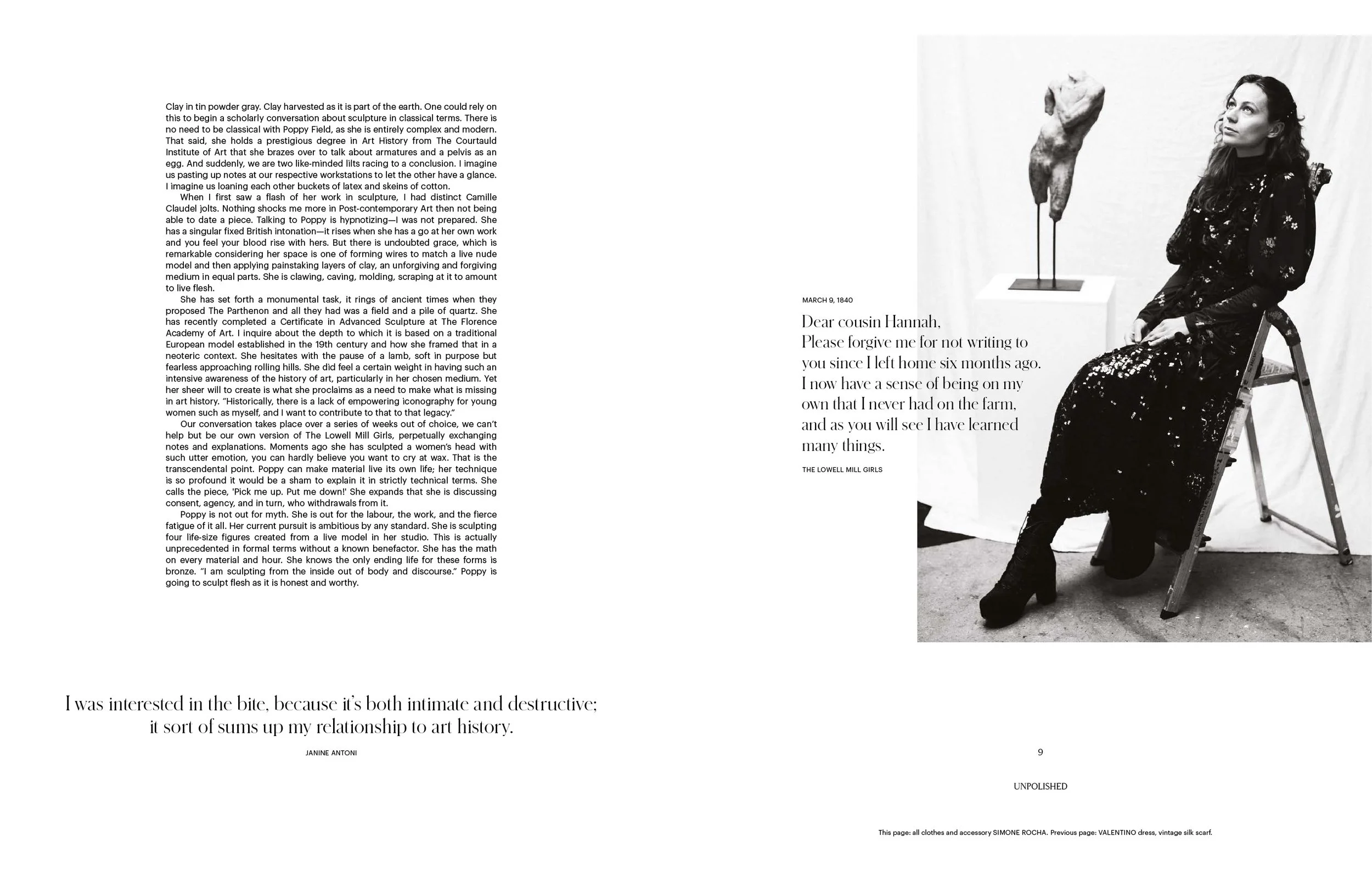
UNPOLISHED MAGAZINE, Book 07, Autumn/Winter 2019/20, The New Wave. pp.6-9,
THE FORM OF POPPY FIELD
Extract from text by Brit Parks. Archival scan available on request.
“Our conversation takes place over a series of weeks out of choice, we can’t help but be our own version of The Lowell Mill Girls, perpetually exchanging notes and explanations. Moments ago she has sculpted a women’s head with such utter emotion, you can hardly believe you want to cry at wax. That is the transcendental point. Poppy can make material live its own life; her technique is so profound it would be a sham to explain it in strictly technical terms.”
“Poppy is not out for myth. She is out for the labour, the work, and the fierce fatigue of it all. Her current pursuit is ambitious by any standard. She is sculpting four life-size figures created from a live model in her studio. This is actually unprecedented in formal terms without a known benefactor. She has the math on every material and hour. She knows the only ending life for these forms is bronze. “I am sculpting from the inside out of body and discourse.” Poppy is going to sculpt flesh as it is honest and worthy.”
The Courtauld News, 2018
A Monumental Education
Poppy Field (BA 2016) discusses life as a Contemporary Sculptor in Florence
My instinct to sculpt informed every moment of my undergraduate studies at The Courtauld. I had spent my gap year training in figurative sculpture at the Florence Academy of Art (FAA) and desperately wanted to believe in the continuing significance of this craft. Though bronze figurative sculpture is rarely championed in contemporary arenas, I found encouragement in its persistence in the public sphere.
But declarations cast in bronze are not made permanent by their medium. I soon realised the irony; if I were to pursue a career as a sculptor, public works would be my greatest challenge. There exists a highly contentious space between public desire for commemoration and actual monuments that have served to validate particular political, historical, cultural and social perspectives. Assigning singular memory and meaning to complex ideas risks political unrest in the present. Recently, an unbuilt and not yet designed monument, intended to commemorate Portugal’s history of slavery, has ignited a fierce debate about historical suffering and continuing issues of race.
The ongoing global debate about the role of public sculpture and new technologies provides the most incredible breeding ground of inspiration and opportunity. As my BA in History of Art progressed at The Courtauld, I began to wonder how I might appropriate a classical sculptural language for contemporary interests. And, how this might be used for bronze figurative sculpture in public spaces.
Picasso said: ‘Learn the rules like a pro, so you can break them like an artist.’ Just consider the works of Hugo Wilson and Grzegorz Gwiazda, two classically trained artists a decade or so ahead of me. I could see great potential at the interface between academic and contemporary art and knew that I would need to complete my own training. So, on graduating from The Courtauld, I returned to the FAA, supported by the Finnis Scott Foundation through the Queen Elizabeth Scholarship Trust and, in my final year, a Study Abroad Studentship awarded by the Leverhulme Trust.
The FAA is extraordinary. The academy is housed in a 19th century customs office transformed into a 35,000 sq ft campus with an abundance of northerly lit studios. It offers every facility that a young artist could hope for. From a purely technical standpoint, Robert Bodem’s pedagogical concept ‘Drawing in Space’ has equipped me to work in the round across a variety of scales, compose reclining figures, compare and understand visual foreshortening, develop internal structures and model a myriad of forms. Everything is Now was my final sculpture; it represents the culmination of three years of training and nods to my intentions.
I graduated from the FAA in June and was awarded the Graduate in Residence prize for sculpture. This grants me a tremendous freedom of time and space as I begin to evolve my own style. I have in mind a number of multi-figural works to sculpt, which speak of contemporary subject matter through demographic representation within classically inspired compositions. My ambition to collaborate with communities and public bodies in the creation of public works is stronger than ever. In the end, it was my studies at The Courtauld that entirely transformed and gave purpose to my aspirations as a figurative sculptor.
Poppy Field (BA 2016) is a classically-trained sculptor currently living and working in Florence, Italy. In 2015 she was awarded The Alpine Fellowship in association with Fondazone Giorgio Cini, Venice. In 2016, at The Courtauld Institute of Art, she was awarded the John Hayes Travel Award (Beijing and Shanghai) and in 2016 she became a QEST Finnis Scott Foundation Scholar through the Queen Elizabeth Scholarship Trust. In 2017 she was shortlisted for the RBA Rome Scholarship by the Royal Society of British Artists, and was awarded a Work Scholarship from The Florence Academy of Art. In 2017 she also received the opportunity to study abroad through the Leverhulme Trust. In September 2018 she became Graduate in Residence at The Florence Academy of Art.
The Leverhulme Trust, 2017
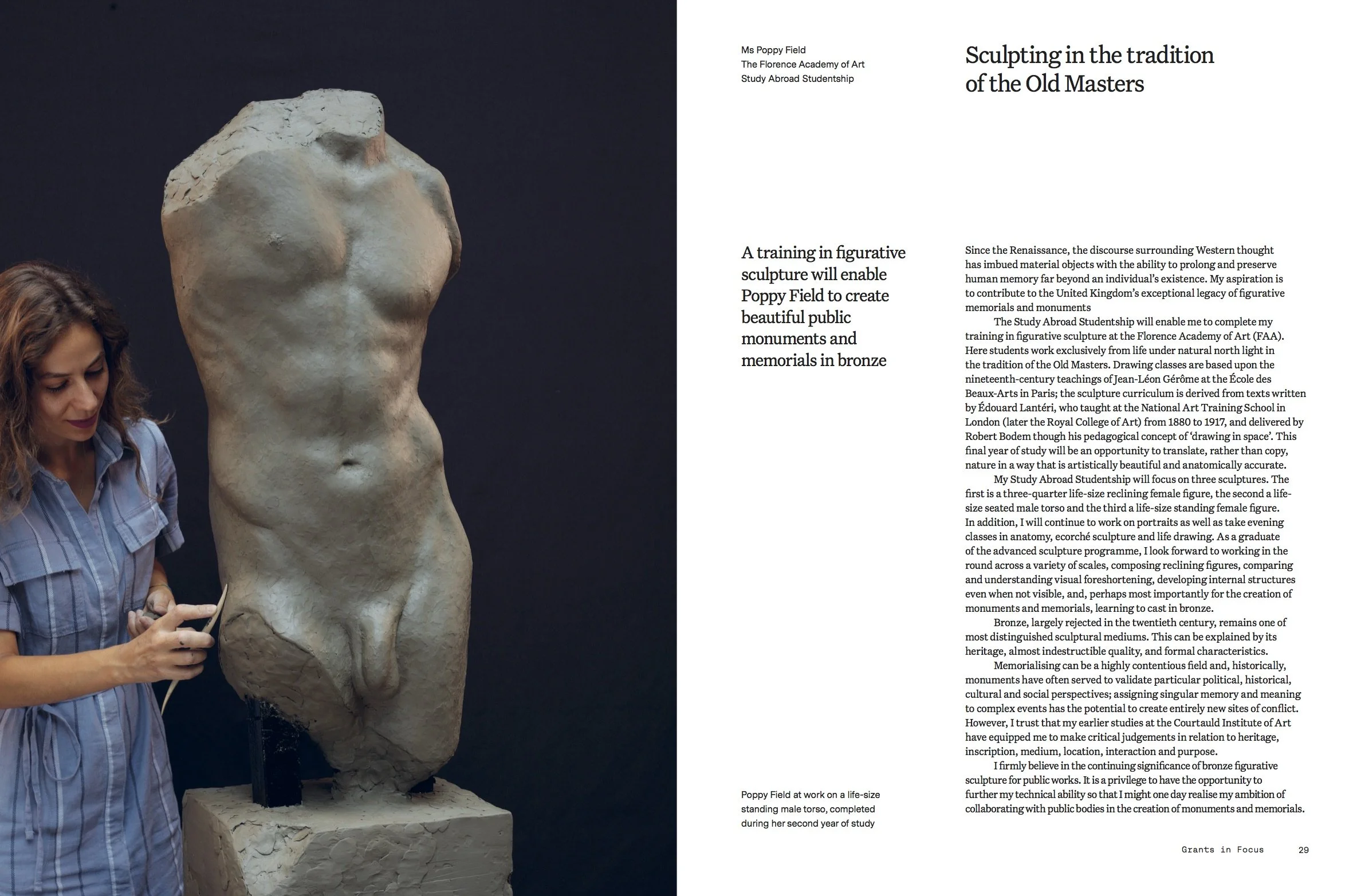
Sculpting in the tradition of the Old Masters
Poppy Field’s training in figurative sculpture will enable her to create beautiful public monuments and memorials in bronze
Since the Renaissance, the discourse surrounding Western thought has imbued material objects with the ability to prolong and preserve human memory far beyond an individual’s existence. My aspiration is to contribute to the United Kingdom’s exceptional legacy of figurative memorials and monuments
The Study Abroad Studentship will enable me to complete my training in figurative sculpture at the Florence Academy of Art (FAA). Here students work exclusively from life under natural north light in the tradition of the Old Masters. Drawing classes are based upon the nineteenth-century teachings of Jean-Léon Gérôme at the École des Beaux-Arts in Paris, while the sculpture curriculum is derived from texts written by Édouard Lantéri, who taught at the National Art Training School in London (later the Royal College of Art) from 1880 to 1917. This final year of study will be an opportunity to bring together everything I have learned by translating, rather than copying, nature in a way that is both artistically beautiful and anatomically accurate.
My Study Abroad Studentship will focus on three sculptures. The first is a three-quarter life-size reclining female figure, the second a life-size seated male torso and the third a life-size standing female figure. In addition, I will continue to work on portraits as well as take evening classes in anatomy, ecorché sculpture and life drawing. As a graduate of the advanced sculpture programme, I look forward to working in the round across a variety of scales, composing reclining figures, comparing and understanding visual foreshortening, developing internal structures even when not visible, and, perhaps most importantly for the creation of monuments and memorials, learning to cast in bronze.
Bronze, largely rejected in the twentieth century, remains one of most distinguished sculptural mediums. This can be explained by its heritage, almost indestructible quality and formal characteristics.
Memorialising can be a highly contentious field and, historically, monuments have often served to validate particular political, historical, cultural and social perspectives; assigning singular memory and meaning to complex events has the potential to create entirely new sites of conflict. However, I trust that my earlier studies at the Courtauld Institute of Art have equipped me to make critical judgements in relation to heritage, inscription, medium, location, interaction and purpose.
I firmly believe in the continuing significance of bronze figurative sculpture for public works. It is a privilege to have the opportunity to further my technical ability so that I might one day realise my ambition of collaborating with public bodies in the creation of monuments and memorials.
Archive Features
Women in Arts Network, July 2026
Why Poppy Field’s Bronze Sculptures Are Worth a Closer Look
Extract from text by Arora, Lisa. Full article available on request.
“Some sculptures impress you technically. Others stay with you emotionally. The work of Poppy Field somehow manages to do both at once.
Her sculptures feel classically beautiful. The anatomy is carefully observed, and the surfaces carry extraordinary sensitivity. The longer you sit with her work, the more something else begins to emerge beneath the technical precision.
Presence. Not simply the presence of a body, but the feeling of a person existing within it. There is tenderness in the way she sculpts posture. Stillness in the way expressions settle quietly across a face. Even her monumental public works feel deeply human rather than distant or ceremonial. Her figures do not appear frozen in perfection. They feel emotionally inhabited.
For her, sculpture seems less about recreating appearances and more about preserving something fragile and invisible: memory, emotion, identity, grief, vulnerability, and the quiet psychological atmosphere that exists around people long before words do.”
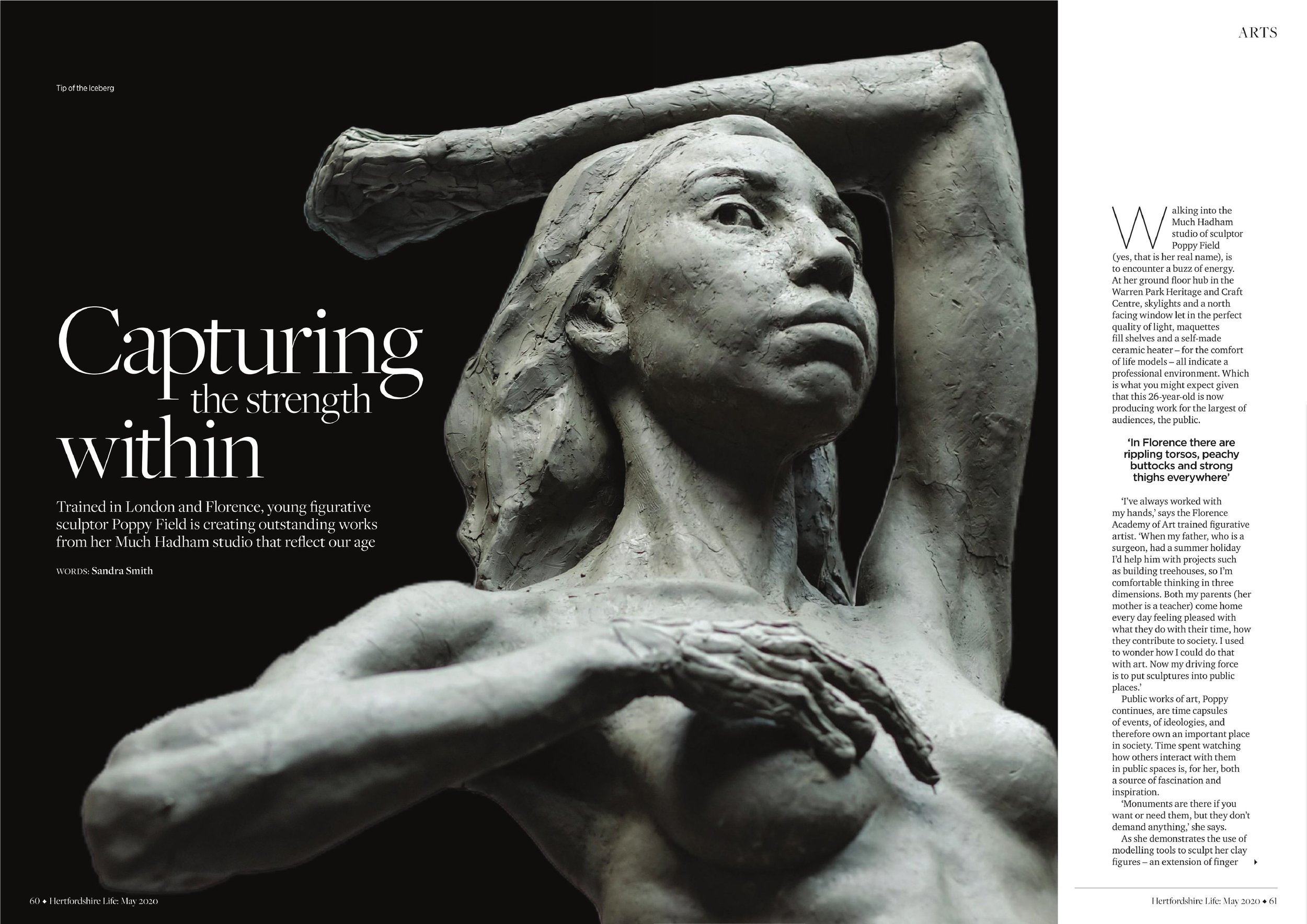
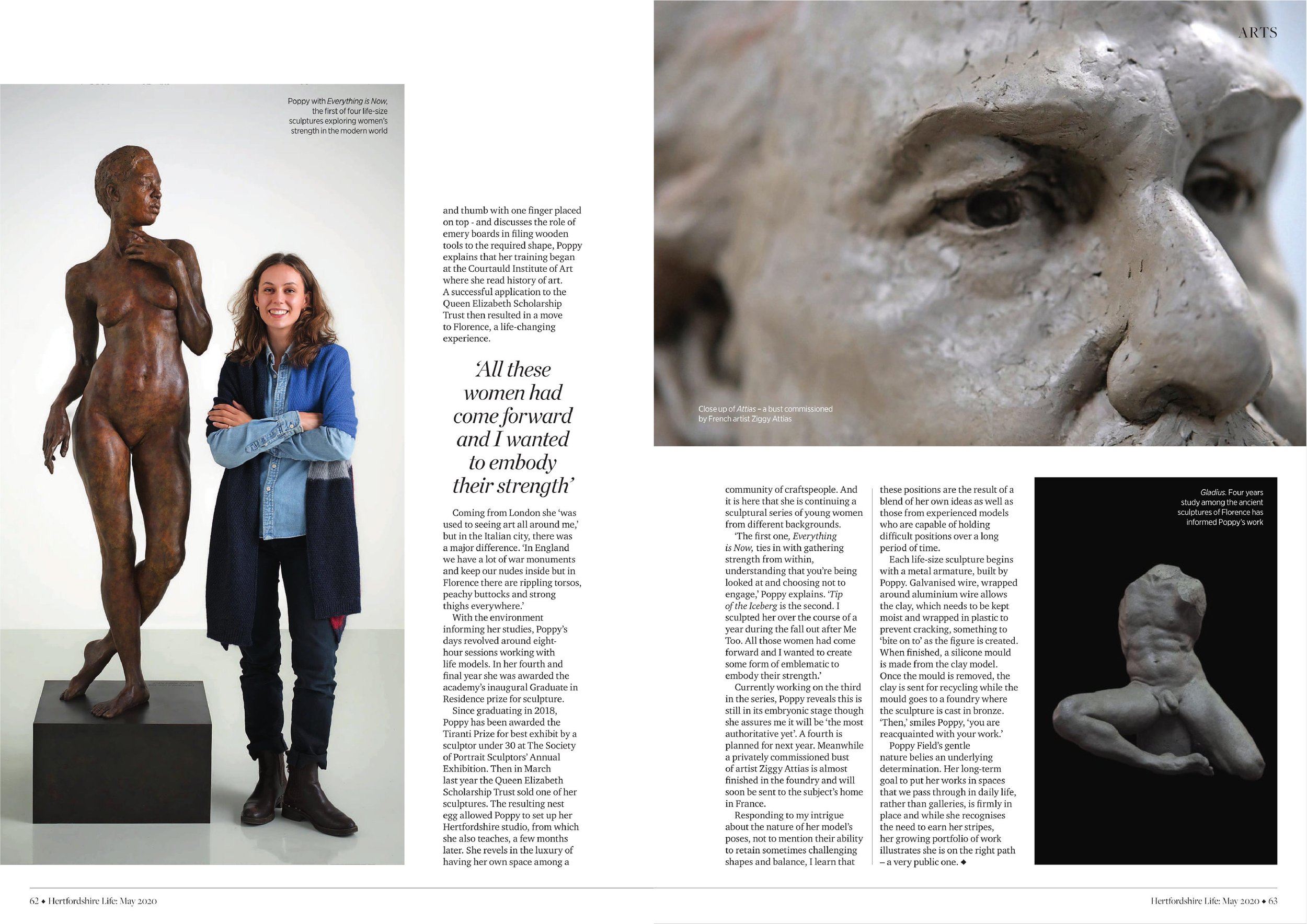
Hertfordshire Life, May 2020 pp.60-2
Capturing the Strength Within
Extract from text by Smith, Sandra. Archival scan available on request.
“Poppy Field’s gentle nature belies an underlying determination.”
“Her long-term goal to put her works in spaces that we pass through in daily life, rather than galleries, is firmly in place and while she recognises the need to earn her stripes, her growing portfolio of work illustrates she is on the right path — a very public one.”